Thursday, April 23, 2020

Can this country be saved? (Should it?)

When I was a kid, my bathroom reading was a column in the Ladies Home Journal called "Can This Marriage Be Saved?"  I don't know why, as a kid not even ten years old, this column fascinated me.  Maybe it was the endless screaming matches between my own parents giving me a hope that maybe the magazine people could finally get things to quiet down.  (The screaming between my parents eventually stopped in April 1967 when my father decided he'd had enough, but then my mother's screaming became directed at my sister and me, so I'm not sure what we gained.)

Today, we wake up every morning in a country where neighbors are posting on NextDoor where you can find toilet paper and where people are lined up at 3 AM to buy cheap surplus chicken from  processing plants that are either closing or are in danger of closing because of COVID-19 outbreaks. We live in a country where you can be guilt-tripped because you aren't getting no-contact takeout food, which you aren't getting because you've realized that restaurant food has never been about the food, but about the companionship of enjoying it with friends.  It's a country where your hair salon has a GoFundMe to try and pay the rent so that at some indeterminate time in the future it can reopen, where you write checks for your hair stylist, the woman who waxes your eyebrows, your petsitting service, and the woman in your city who for years has been feeding kids in her low-income neighborhood and now finds herself an indispensable resource for a need that seems bottomless. It's a country where hedge funds gobbled up loans that we were told were meant for small businesses, where a pittance of $1200 for every adult in the country was deemed to be sufficient to carry over  people who had to close their restaurant, their beauty salon, their massage therapy practice, and the people who worked for them.

Some of us have been screaming for two decades about the mindless, knee-jerk patriotism that rose after 9/11/01.  It never really went away, as a party in power for much of that time sold us off piecemeal to billionaires who believe themselves ordained by God to have all the wealth in the world.  Meanwhile, the opposition party stubbornly remained locked in a bygone era, trapped in a 1990s "centrism" that was never in the center and was less a sea change than a function of the most charismatic politician since JFK.  That "America Fuck Yeah" patriotism had no resemblance to the country we actually lived in -- the one where a college education, unless you were a brilliant STEM grad from a top college who'd had an internship at Google, maybe got you a job at Starbucks if you were lucky.  It was one where undocumented workers who were required because Americans don't do backbreaking work for pennies an hour, were being exploited by their agribusiness employers for pittance wages. It was one where even tech workers were having to train their own lower-wage replacements, whether here or in India, before being let go.  Black men were being summarily executed in the street, or in their cars, because someone of the same race was seen in the same neighborhood, or because they'd committed some petty crime that for a white person would have meant pretrial intervention and probation.  The middle class was being systematically eviscerated, while the billionaire-owned GOP pointed their attention down the ladder and said "Look!  Look at that [black person/immigrant/Muslim/Jew/whoever]!!  HE's your problem.  HE's the one taking what is rightfully yours!"

And the middle class bought it -- enough of them to put Donald Trump in the White House.

Yesterday I spoke with a friend who I haven't talked with since November.  One of the reasons for that is that every time I talk with her, she insists on rehashing the entire sad story of the 2016 election, and what "we" have to do now -- as if I'm arguing with her.  The amount of energy she expends on what was absolutely a travesty is toxic -- and wasteful.  After I finally was able to get a word in edgewise, I asked her "What is this doing for you?  What is this doing for anyone?  What is this doing for anything?"  Eventually I got her to ask the question, "So what do we do?  How do we fix this?"

It's so much easier to stay stuck in 2016, to rehash the injustices done to Hillary Clinton -- a candidate who, if her husband was the most charismatic politician of the tech era, was probably the least charismatic, and certainly the most tone-deaf one -- than be a cynic like me and face the inexorable fact:  That if we were ever "America the Great", we certainly aren't anymore.  The myth has been held together with spit and glue ever since Ronald Reagan's first act in office was to fire all the air traffic controllers.  The public has been bought with $300 "tax rebates" while billionaires got millions in permanent tax cuts; and poisoned by right-leaning corporate media.

And now here we are, in what George Packer accurately called in The Atlantic this week, a failed state:

The crisis demanded a response that was swift, rational, and collective. The United States reacted instead like Pakistan or Belarus—like a country with shoddy infrastructure and a dysfunctional government whose leaders were too corrupt or stupid to head off mass suffering. The administration squandered two irretrievable months to prepare. From the president came willful blindness, scapegoating, boasts, and lies. From his mouthpieces, conspiracy theories and miracle cures. A few senators and corporate executives acted quickly—not to prevent the coming disaster, but to profit from it. When a government doctor tried to warn the public of the danger, the White House took the mic and politicized the message.
Every morning in the endless month of March, Americans woke up to find themselves citizens of a failed state. With no national plan—no coherent instructions at all—families, schools, and offices were left to decide on their own whether to shut down and take shelter. When test kits, masks, gowns, and ventilators were found to be in desperately short supply, governors pleaded for them from the White House, which stalled, then called on private enterprise, which couldn’t deliver. States and cities were forced into bidding wars that left them prey to price gouging and corporate profiteering. Civilians took out their sewing machines to try to keep ill-equipped hospital workers healthy and their patients alive. Russia, Taiwan, and the United Nations sent humanitarian aid to the world’s richest power—a beggar nation in utter chaos.
 When the Trumpublican Party passed massive tax cuts for corporation and billionaires in 2019 along with some smoke and mirrors designed to make the masses think they too were getting tax cuts, pundits and economists warned that these unnecessary tax cuts would give little room for stimulative spending in the event of a recession.  And here we are, but it is an election year so politicians of ALL stripes decided it was necessary to throw a pittance of hush money at the masses.  And right on cue, there was Steve Rattner, on the supposedly "liberal" MSNBC this morning, already talking about the "spending cuts" that will be necessary when this is over.

We all know what "spending cuts" means:  It means eliminating or gutting Social Security, Medicare and Medicaid.  "But they can't do that.  They'd never be re-elected" you might say.  Oh, it won't happen this year, at least not before whatever passes for an "election" in November.  But you can bet your life that the minute that election is over (and you may rest assured that the GOP WILL prevail, by hook or by crook, most likely the latter), the knives will be out.

Perhaps this is why SARS-CoV-19 has been allowed to run rampant -- to cull the herd enough that there will be little opposition to finally fulfilling the GOP dream.

(Side note:  I have not even addressed the influence of Russia and Vladimir Putin's string pulling on the current occupant of the White House.  Some things are best left to the professionals.  For that, I refer you to Greg Olear, who knows of what he speaks.)

Thursday, April 2, 2020

The short memory of an inattentive American public

Frida Ghitis, in The Atlantic:

Give the president his due: Trump is a genius. He is a master manipulator, a political alchemist capable of transmuting calamitous errors into political gold. Even as he continues to lie and deceive, the president has seized control of the narrative, taking possession of the national microphone to saturate the public with his self-serving version of events.

And it’s working.

All the fact-checkers, scientists, journalists, doctors, nurses, mayors, and governors may be telling a different story. But Trump takes to the White House podium day after day, crafting a narrative, offering the same staccato sentences over and over—“We’ve done a great job”—taking credit for each positive development, conjuring nonexistent progress, blaming others for every failure, demanding that those around him sing his praises before the cameras, and extorting praise from governors in exchange for federal aid. He repeats this until the extent of his failures, however well documented, fades from the minds of a large segment of Americans, desperate to feel protected in the face of a mysterious and frightening threat.

*********************************

This is what happens when Americans listen with only half an ear to what's on the 20-minutes of network news.

News junkies like me see his press conferences delivered in their entirety, in real time, followed by an analysis of every lie he tells.  But the network news programs that people may watch over dinner are simple stenographers.  When that's what they hear, that's what they believe.

I always cite the example of my friend whose kids were never allowed to play in their own backyard unless she was out there with them. Every morning, she would have "Good Morning America" on, and in those days of the aftermath of the Elizabeth Smart kidnapping, every morning they led with a story of a missing [white] child.  So she was convinced that in her suburban neighborhood of one-acre lots and 1970s bi-levels, on a dead-end street, where you never saw a soul outdoors, her kids were certain to be kidnapped if they played unattended, even for five minutes. Whatever gets "out there" first, is the truth.

Remember the Swift Boat Liars -- Jerome Corsi's guys who made ads in 2004 that painted John Kerry, a decorated Vietnam veteran, as a traitor?  They got "out there" first, and people who weren't news junkies believed it.  Some of that was because Kerry didn't fight back at all, assuming wrongly that "the American people are too smart to believe that".  But it was also because the Swift Boat Liars got "out there" first.


Trump is getting "out there" first.  Americans have short memories.  He comes out and cites numbers -- big numbers -- and people assume that he's on top of things.  They may know in their hearts what he is, but these are even scarier times than the 9/11/01 aftermath.  And they WANT to believe him. They NEED to believe him.  Because the truth, that the president is a man without a soul, without empathy, without curiosity, without knowledge or any desire to obtain it, a man hopelessly unfit for the office he holds, is just too terrifying to contemplate.

If this is somehow over by the November election, our short memories will kick in.  Trump will get out there on a campaign slogan of "Where Was Biden?" -- as if Biden were the president who dropped the ball and not  him.  And he will win.  Because Americans have shown themselves again and again to be unwilling to face uncomfortable truths.

Wednesday, April 1, 2020

What will American society look like when this is over?

"I can't wait till life gets back to normal."

How many times have YOU heard or said that lately?  I know I have both.

I've been wondering of late what life is going to look like after this virus runs its course, after there's a vaccine and its re-emergence every year becomes like the flu.  In order to do that, we have to look at how life has changed and how we're adjusting.

Service businesses. I get my hair cut every five weeks.  I have a short haircut, which needs shaping regularly or it will look like a thinning mop.  The salon I go to is closed, I'm due for a haircut next Tuesday, and it's not going to happen.  And I have no idea when it will.  I'm trimming and tweezing my eyebrows myself and hoping I don't botch it.  I had a pedicure before the stay-at-home order, and won't have another one for a long time.  What little vanity I had has fallen by the wayside.  I think about people who regularly get their nails done, get their hair professionally colored, get facials and Botox and fillers and hair highlights and all the other things we do to pretty ourselves up and how we are all going to have to live with being somewhat unkempt.  There was a time when this "beauty industry" didn't exist.  Look at photos of your great-grandmother.  She didn't create a smoky eye and have lash extensions, and yet she managed to live a life, and even look pretty.  Will this teach us to relax about all this?  Then there are the petsitters and child care workers and handymen and the many other small service businesses that have been largely sidelined.  Will they still be there when we need them after this is over?

Corporate office parks.  People whose work takes place sitting at a computer are working from home these days.  I know from experience that especially large companies hate the idea of remote work.  The move towards "open concept office space" that was sold as "fostering collaboration" really does little of that, but is a great way for managers to do surveillance of employees to make sure they're busy. When your people are working at home, unless you are using keystroke loggers, there's a level of trust required that most companies historically have not had.  The assumption is that people will goof off.  But what if they aren't goofing off?  What if they're working more effectively, taking less sick time, perhaps even giving you the time they used to spend in traffic?  When Zoom allows you to have face-to-face meetings online, do you really need to sit in the same room with a pot of coffee and a tray of pastry?  Suppose companies DO decide that remote work is viable during all this.  What happens to all those corporate office parks with their on-site gyms and dry cleaners and cafeterias and huge lawns to maintain?  Do we need them?  Can a smaller facility for OCCASIONAL face-to-face meetings suffice?  Is there a better use we can put that land to, like, perhaps, replacing some of the farmland and forests that we've been clear-cutting for stick-built firetrap apartment buildings?

Restaurants.  Oh, the poor restaurants. It's estimated that up to 75% of this country's restaurants may never reopen.  We've been restaurant-crazy ever since we became foodies with the advent of the Food Network in 1993.  Today, mayonnaise with stuff mixed in is an aioli, everyone knows what a chiffonade is, and thanks to YouTube, everyone is a chef.  Here in Durham, NC, the foodie capital of the south, our downtown renaissance has been largely fueled by a thriving and dynamic restaurant scene and local celebrity chef culture, to the point that saying you have no idea who Ashley Christensen is, is met with the kind of horrified reaction one would get by saying one has spent one's entire previous life in northern New Jersey.  Many restaurants are doing what they can to switch over, at least temporarily, to a takeout-and-delivery model, but not every restaurant can do that, and even so, many people are leery of food of unknown origin and treatment.  It's one thing to simply block out the thought of a line cook who may not have washed his hands, but quite another when a deadly virus is at the front of everyone's mind.

The first casualty has been the Chinese restaurants and takeout joints.  If we are adept at nothing else, Americans are great at ethnic scapegoating, and the family-owned Chinese restaurants that neighborhoods all over the country rely on to deliver tasty, inexpensive Americanized versions of Chinese food in copious portions, were the first to suffer the consequences of American hysteria over a virus that originated in China.  Ordering a quart of wonton soup and a plate of mei fun has never seemed so revolutionary.

With restaurant dining now being just another manifestation of eating at home, many people are not bothering.  Will we go back when this is over?  Probably -- assuming there are restaurants to go to. Restaurants, like hair salons and other mom 'n' pop service businesses, operate close to the edge at all times, and most cannot absorb being out of business for an extended time.   Even good cooks are going to be tired of their own cooking in another few months, but will there be alternatives other than mediocre chain restaurants?

Low-wage workers.  Health care workers are on the front lines of this pandemic, but there is a group of people who are very quietly going about their business, making sure that we have what we need.  They are the people for whom the GOP has nothing but contempt, and the Democrats have long forgotten, enthralled as they have been with technocrats and big donors.  It's the low-wage workers -- the supermarket cashiers and stock clerks and night crews.  It's the restaurant cooks and packagers, the food delivery drivers and Amazon warehouse workers.  These folks are going to work, exchanging money with and handing receipts to people whose COVID-19 status is unknown.  They are keeping us stay-at-homes supplied with what we need (except toilet paper, there's still a shortage as I write this), and they're doing it in most cases for minimum wage or little more.  Last week I was at an Aldi, watching a woman not much taller than I am, putting bottles of ketchup on a shelf.  I said to her, "Thank you for your service."  Now military families may be outraged at that, but with military service, and certainly with health-care work, there is a certain amount of assumed risk.  Supermarket workers aren't usually required as part of their jobs to be exposed to deadly viruses on a daily basis.

These people, not corporate executives (especially the ones Trump is allowing to do commercials at his daily pressers), are clearly the ones keeping what little of the economy remains functional going.  And yet, the GOP is worried that some laid-off low-wage workers might get a few bucks more on unemployment for a few months than their wages.

When this is over, I hope we remember what they are trying to do every single day to keep us stocked with groceries, medications, and paper goods.  And that we fight for better wages for them.

Great Big Stuff.  I linked here to the eponymous song from "Dirty Rotten Scoundrels"  deliberately, which you'll understand about 1:25 into the video.  But for the rest of us, what will our housebound ways mean for the consumer society?  We're not driving, so we don't really need to buy a new car right now.  Designer clothes?  Why, when we're all at home.  And you know what?  Being comfortable and walking around the house barefoot is a lot nicer than teetering around in stiletto heels.  Our dishes are perfectly functional, we're watching movies on TV without 20 bucks worth of soda and popcorn, and we're somehow managing to thrive even with the malls closed.  The only Great Big Stuff anyone seems to want these days is a 30-pack of toilet paper from Costco.  Will we go back to our consumerist ways when this is over?  Or will we decide that we LIKE having fewer cars on the roads, less traffic, lower credit card payments every month because we are charging less consumption.

Medical Conspiracy Theories.  So where are the anti-vaxxers now?  Where are the snake oil salesmen -- the Dr. Axes and the herbalists and the people claiming that something you pull out of the soil in its native form is by definition always better than anything that actual scientists come up with.  These people have been pretty silent these days, while everyone is listening to the great Anthony Fauci explain in language even an idiot can understand what clinical trials are, how a Phase I trial is primarily about safety with efficacy only as a secondary endpoint and why often later trial phases are necessary.  He's educating people about how fast tracking works, how vaccines and treatments will work, and why taking chloroquine in fish tank cleaner is not the same as taking it in a tolerated-dose-tested tablet.

And then there are the health care workers in the trenches -- the doctors and nurses and aides and PAs and NPs and everyone out there who is reporting to work in what is essentially a war zone, abandoned by an incompetent and narcissistic president who STILL refuses to acknowledge what his dithering has done.  These are the people that too many Americans have lumped in with what they call the Great Medical Establishment Conspiracy -- money-grubbing crooks who do nothing but steal money from people, unlike the Great and Virtuous Herbalists and other quacks who also sell stuff online, but for some reason they have of late had more credibility than actual scientists -- on both the right AND the left.  Health care workers do miracles every day -- and now they are likely to be asked to take on the responsibility of determining whose life is saving and whose is not -- because there are not going to be enough ventilators and respirators to go around, thanks to Trump and his "pro-life" GOP.

I hope that we will be kind to all these people and stop the nonsense when this is over.  Yes, let's hold price-gouging pharma companies' feet to the fire.  But let's stop this assumption that science and medicine know nothing.

For more on the post-COVID-19 medical landscape, listen to Dr. Zubin Damania:


Universal health care.  So....how's that "we can't afford universal health care, let's just tinker around the edges of the ACA" working for us?  Seriously.  How's that employer-based health insurance working for people at a time when unemployment claims number in the millions?  COBRA?  Really?  MY COBRA was almost $700/month.  When too many Americans wouldn't be able to scrape together $400 for an emergency, how do they pay that?  Those with families can have COBRA premiums of $1500-$2500/month.  How are they supposed to pay that?  And those without income for a sizable part of the year and who have a subsidized ACA plan may find themselves having to pay back that subsidy at the end of the year BECAUSE of their lack of income.

You can hate Bernie Sanders all you want to for staying in the race long after it's been established that the clueless and out-of-touch Joe Biden will be the one to run against Trump in November.  But if he stays in to keep the Democrats' feet to the fire on universal health care in the face of this pandemic, he'll be doing a public service.  Because the insurance model of health care delivery falls apart in the face of a pandemic like this.

And finally.....

Big Government and the I Got Mine And Fuck You society.  As I write this, Florida's extreme right-wing, Trumpazoid governor, Ron DeSantis is refusing to issue a stay-at-home order until Trump's task force tells him what to do.  Other governors are complaining that they are having to compete with other states for personal protective equipment for their states' health care workers -- like medieval street rabble scrambling for the few potatoes falling off the royal cart.  Viruses don't care about states' rights, or what the Heritage Foundation thinks about big federal government.  There really ARE things that are a national problem. When unemployment is going to be at 30% nationwide, relocating for a job is not even an option.  Every part of our vulture capitalist financial system is up for questioning now and if ANYTHING good comes out of this, it's going to be a long-belated end to the trickle-down idea of capitalism that Ronald Reagan foisted on us in the 1980s, and which the GOP has been using to screw over working people ever since.  It's going to be an end to the idea of "I don't want to pay for your health care."  Because guess what?  We are ALL going to be paying for each other's health care with this, one way or another.

We are NOT rugged individuals carving out the way west with our bare hands.  We are NOT Pa Wilder, building the Little House in the Big Woods and the Little House on the Prairie.   Yes, we are individuals, but we are also living in and part of a larger community.  Right now we are taking care of each other by staying away from as many people as possible so we don't infect them.  We go grocery shopping for our 85-year-old neighbor and our immunosuppressed friend.  We create Zoom meetings to keep in touch while we're at home.  We call people to make sure they're OK.  We take care of each other.

And when this is over, let's continue to do that.  Because it has become clear that I Got Mine And Fuck You is not a sustainable or civilized model to live in.


Sunday, March 29, 2020

Life in the time of COVID-19

Hello, fellow denizens of the Handbasket to Hell!

When I decided to start blogging again, I really thought I was ready to pick up the mantle again.  I really did.  After all, we were now living in a time when Goddess knows there was plenty to rant about.  But perhaps it's too much.  So I find myself in a state of paralysis.

Oh, I've started more posts than I can count.  The last one I started and couldn't finish was about Chris Matthews, who I loathed so much that I once started an entire blog devoted to his awfulness, who after his management grew weary of his hysteria over Bernie Sanders, decided to take his dollies and dishes and go home and sulk.  But I wasn't able to finish it.

Truth be told, I have never regained my focus and concentration.  I lost it during Mr. Brilliant's illness, and it has never come back. Right after he first died, I chalked it up to "widow brain" -- the fogginess that often occurs after someone loses a spouse that makes us unable to concentrate on anything and can even put us at risk of Alzheimer's. Oh, I stayed at The Job That Ate My Life for another four years, mostly with the help of an amazing colleague from a clinical research organization who covered a multitude of sins and took on the detail work that I was no longer able to do.  I was fine with meetings, and deciphering protocols, and understanding how to do disease assessment in various kinds of cancers.  But the intensely detailed work of my day-to-day tasks was beyond my ability.

And so it has been with blogging.

I've been thinking about this lack of focus for the last few days, as like many Americans, I am under a stay-at-home order due to the coronavirus pandemic. One would think that without flitting around here and there, going out to lunch with friends, or to the gym, or to a movie or concert, I'd be getting things done around the house.  But one would be wrong.  I've managed to put together an exercise regimen thanks to tai chi and YouTube workout videos.  But most days, I turn around and suddenly it's 2 PM and what have I done?

I find myself thinking about Mr. B. a lot these days.  I used to think about what I would have to fill him in on if he were to suddenly come back from the dead (something that still happens frequently in dreams) -- about how Facebook and Twitter seem to now run our lives and about how a smartphone is mandatory now.  I'd have to tell him that he really didn't miss anything by missing the last episodes of Dexter, and about how Game of Thrones ended. I'd have to tell him about Uber and Lyft and Instacart and Hulu and how he shouldn't even TRY to find a full-time job because EVERYONE is in the gig economy now.  But most of all, I'd have to explain to him about how Donald Trump became president.  Sometimes I can even hear him laughing about that, because for someone who had a finely-honed sense of irony and the absurd, President Donald Trump is the most ironic, absurd thing EVER.

I find myself alternately feeling bereft that at this time when impending doom seems right around the corner,  I am in this house alone talking to the cats, and being grateful that I only have to worry about myself right now, because to be honest, I don't have much energy for anything else.  I think that when Mr. B. became ill, my customary hyperemotionality went largely numb, and like my concentration, never really came back.  So I'm not overly anxious in the way to which I was once accustomed, but there IS a constant sense of being unsettled, of the earth being tilted off its axis somehow. And sometimes I think Mr. B. was the smart one back in 2013, when his medical condition offered him a chance to exit what he called this "God-forsaken level of reality" without pain or fear.

Oh, don't worry, I'm far from suicidal.  In fact, before SARS-CoV-2 came along to remind us that Mother Nature has pretty much had it with our miserable species, I was living a pretty contented life, with good new friends, staying in touch with old friends, a home that I love in an area full of music and culture and mild winters. People have even stopped asking me if I'm "dating" (an absurd concept in the over-60 crowd), much the way they stopped asking me if I had changed my mind about not having children once I turned 50. Moving away has allowed me to remember the life I used to have without being stuck every day in a constant reminder that I don't have it anymore. But living in a constant state of dread, as if the world I live in has become a distorted funhouse mirror of the one I know, has me feeling deeply unsettled.

I suspect that's prevalent these days.

I know more about ventilators and breathing tubes than I wish I did, and all this relentless talk of ventilators is making my brain retrieve images of Mr. B. in those last two weeks of his life in the neuro ICU of a hospital that is currently moving patients like he was off to other facilities so they can focus on COVID-19 patients.

I hope you are all doing as well as can be expected.  Who knows, perhaps this country will do some soul searching during all of this and we'll come out on the other side with better awareness that "America Fuck Yeah" is no basis for a system of government OR a culture.

Monday, December 30, 2019

R.I.P. Skippy. Happy Blogroll Amnesty Day.

There was a time, now very far away, when most political bloggers kind of sort of knew each other.  Some knew each other better than others, crossing over into "meat world," and others only knew each other online.  Many of us stopped blogging somewhere along the way, only to pick it up again later, but there were others who kept on going.

When Steve Gilliard died we were all still blogging and word spread like wildfire.  Since then, we've lost so many -- Doghouse Riley, "Jon Swift" (Al Wiesel), Bob Rixon, and just this month we lost Shaun Mullen of Kiko's House.  But perhaps no loss cuts deeper than finding out only now that last summer, unbeknownst to me, we suffered the unfathomable loss of the whimsically named "skippy the bush kangaroo," who equally unbeknownst to me, was author/actor/comedy writer Gil Christner.  Joe Gandelman wrote about him after his passing.

Skippy was one of those "big name bloggers" who always had room for us smaller folk.  He didn't care if you were famous, or if people would recognize you at Netroots Nation, or if you hung around with Markos the Huge.  Skippy was one of the founders, along with Al Wiesel, of "Blogroll Amnesty Day."

Because the families of Jon Swift (I will use his blog name from here on out) and Skippy did not see fit to allow their blogs to remain up (though both can be somewhat seen through the Wayback Machine via the links in this paragraph), you won't get the chance to really see how these two guys were the ones who formed a true community of progressive bloggers who DIDN'T pull up the ladder behind them.

Blogroll Amnesty Day started as a giant "Fuck you" to one of those ladder-pullers, Atrios, who for seventeen years has managed to build and sustain a huge following with one- and two-sentence posts.   In 2007, Atrios decided that he would purge his blogroll of all but the blogs he deemed "important", and gave himself amnesty to do so.  Amnesty against what, I don't know, unless it's amnesty for becoming exactly what progressives were fighting against.  At the time, Jon Swift wrote:

This past weekend Atrios, the proprietor of Eschaton, declared a Blogroll Amnesty Day, saying, "one of the big complaints by new bloggers is that it's impossible to get onto blogrolls because established bloggers tend not to add them." I thought that adding new lesser-known blogs to his blogroll would be a wonderful idea. Although for some inexplicable reason that I am at pains to discover, Atrios has never seen fit to link to me, I, nevertheless added Eschaton to my own blogroll and introduced myself to Atrios with a sincerely sycophantic email, since he is after all a blogging pioneer who deserves our respect.

But the more I learned about this Amnesty Day, the more I realized that it was a very strange amnesty indeed. The amnesty he granted turned out to be amnesty for himself. He wanted to assuage himself of the guilt he might feel at kicking blogs off his blogroll instead of granting amnesty to others to swarm across the border into his domain. "Everyone feels a wee bit guilty about removing blogs from their blogroll, so they're hesitant to add new ones to an ever-expanding list," he explained. So Atrios deleted his entire blogroll and disappointingly repopulated it for the most part with the usual suspects. Then others in the liberal blogosphere followed his example, including Jesus' General and PZ Myers at Pharyngula, who already takes a very Darwinian survival-of-the-fittest approach to blogrolling. Then Markos at Daily Kos joined this ruthless bloodletting. "It sucks and it feels bad," he said, daubing the tears from his eyes as he typed. So the end result of Atrios' Amnesty Day was to make some blogrolls smaller and even more exclusive than they already were.

Thus began the teaming of Jon Swift and Skippy to appropriate Blogroll Amnesty Day for mere mortals and make it an annual celebration of newer and smaller-readership blogs, combined with an exhortation to "Look up!  Link down!"


Since Jon Swift left this mortal coil, blogger Batocchio at Vagabond Scholar has been carrying the torch for these two most generous men; both professional writers who got paid for their work, but toiled away in the trenches with the rest of us under their pseudonyms, encouraging us and asserting that what we were doing had value.

Without further ado, here is this year's entry, renamed now to the Jon Swift Roundup.  I hope you'll click through and read these self-selected posts by some of the long-timers as well as those who picked up sociopolitical blogging long after it was left for dead by many.

Rest well, skippy.  The world is a darker place without you.


Wednesday, December 18, 2019

This is how it happens. This is how it has ALWAYS happened.

The Wifely Person writes about the signal that the current occupant of the White House sends by inviting "Pastor" Robert Jeffress to, of all things, the White House Hanukkah party:

This is the new and improved version of anti-Semitism we've all be waiting for. Feckless hails Jeffress as a tremendous faith leader, and invites him to attend a party with the people he damns to hell, including that hot tamale Ivanka and her husband, Jared. What kind of father does that to a child, even Ivanka? Especially when her children would be mischling. This is a father who doesn't give a brass farthing for his kids. ME, ME, ME, it's all about ME! 
All this on the same day Feckless Leader signed that ridiculous order that made Jews a nationality, and creates Jews as a distinct nation, NOT American.
If you've ever wondered how both the guys in the black hats can be Jewish AND people like me, who eat pork (though frankly, I think that's over thanks to the new Trumpian USDA relaxing of regulations) and scallops and almost never see a synagogue and celebrates the Solstice can be Jewish, I recommend you click through to the above to see exactly WHY Trump's declaration that Jews are now a nationality is so terrifying.

Because you can eat bacon, you can attend a Buddhist temple, you can take your non-Jewish spouse's name (as I did just to get out of the end of the alphabet), you can put a Christmas tree in your house, you can do all the yoga you want, read all the Robert Thurman you want, you can deny it forever, but when the brownshirts come, all they're going to care about is the origins of your blood.  The only exceptions are going to be those who very ostentatiously become baptized in an evangelical church -- and even THOSE are going to be suspect -- and those who are willing to rat out the Jews in their neighborhoods and social circles, and even THOSE are just buying themselves time.

How do I know this?  Because this is how it works.  This is how it happens.  This is how it has ALWAYS happened.

I don't like this paranoia I'm feeling these days.  My mother had it at a far more benevolent time and I used to say she was crazy.  Six months after her own husband died in 2000, she moved to NC (as I did to the same city fourteen years later), into a house that's no more than about three miles from mine.  You use the same road to get to her first house here as to get to mine.  Our house numbers are similar, transposed by a single digit.  But my mother was who she was, and with her social phobia was unable or unwilling to make friends.  She chalked it up to "They don't like Jews here."

Now I'll grant you that 18 years ago, there were fewer transplants here.  But I still believe that my mother's isolation was her own doing rather than due to some kind of rampant anti-Semitism in Durham, which was even then a liberal bastion.  She was, after all, kind of a buzzkill.  But I used to laugh at her paranoia, quoting her that scene from "Annie Hall" where Woody Allen is ranting at Tony Roberts about how the waitress was an anti-Semite because he heard her say "Jew eat?" ("Did you eat?").

Mom was being overly dramatic back then, but I have more sympathy for her worldview, now that we know, or at least have extrapolated, more about her family and how her parents and some siblings came here, were homesick, and then went back just in time for Hitler's army to take over Poland. We've theorized that our grandmother had survivors guilt, and in the days before good therapy, took out her grief on her husband AND her children, who then took it out on THEIR children. This is how the Holocaust reverberates through the generations and why seeing the lead-up happening again HERE IN THE U.S. is so terrifying.

I don't intend to spend the rest of my life, however it ends, being terrified.  I'm going to live my life, doing what I can to beat this back.  But  I would hope that anyone who's taken the time to read this will help fight back against this.  We already know that this administration has set up internment camps for people coming in through our southern border, separating families, and if not actively killing them (yet), is neglecting them to death.  Latino soldiers who have fought for this country are being deported, as are people who have lived here for decades as good, productive, law-abiding residents.  Today it's the Latinos.  The signs that the Jews are next are all there.  And let's not forget the pink triangles that were the gay equivalent of the yellow stars and how people who were gay were rounded up because Hitler saw them as an indicator of "decadence."

So even if you or people in your social circle or family  find themselves  believing that the Jews have all the money, or we're weird or smell like pastrami or any other garden-variety form of Jewish stereotyping, consider that when one group, or two groups, or three groups are targeted, NO ONE IS SAFE.

Wednesday, October 23, 2019

Forward into the Past

I first met Pen-Elayne in 1977 at a Jewish singles event in Carteret, New Jersey that was one of the worst social events I ever attended.  It was at the home of a thirtysomething guy who lived with his elderly mother.  All I remember is a bunch of people sitting glumly on couches, except this funny, chatty woman across from me.  It was not the match that the group had in mind, but I think we both recognized kindred weirdo spirits, and we became friends, regularly revisiting that evening and snarking about it far longer than it deserved in our life stories.

I'm not sure how we lost touch, but we did for a couple of years, until I ran into her at yet ANOTHER Jewish singles event, this one populated with FAR more interesting people, and we reconnected once again.

I was shy and introverted, and Elayne was a force of nature.  An imposing figure, she was completely  socially unaware, chatty, ferociously verbal, and with next to no boundaries at all, took over every room she was in.  No one could resist the Force that was strong in that one, even if they tried. This time, our friendship outlasted the end of the singles group, which was discontinued by the YM-YWHA that sponsored it because we weren't producing any Jewish marriages and resulting babies, but were more interested in just having fun.

Through Elayne, I learned about fan culture.  Today, fan culture is so mainstream that movies based on comic books are propping up the movie industry, huge conventions of fans of various types exist in every city in the country, guys like Kevin Smith can become successful filmmakers, and movies based on the Lord of the Rings trilogy (a.k.a. the geek cred holy books) win Oscars, but in the early 1980s, when we reconnected the first time, it was something I knew nothing about.

I was never into comic books OR science fiction, which are still the core of fan culture.  I got tired of comic book movies after the first "Iron Man," though Mr. Brilliant went to every one of them until he became ill. But Mr. B will come into this story later. 

I knew that fandom was about Star Wars and comic books and it seemed to me, as a Very Serious twentysomething who at the time thought I just wanted to work in a creative industry and live like a Cosmopolitan Girl, being taken to nice places by elegant men in three-piece suits, culminating in an Appropriate Marriage, to be kind of silly. I never did become part of the pop culture part of fan culture, but I sort of flitted around the edges of it with Elayne and our friend Anni. 

Most fans are smart weirdos who have at least at some point felt that we have been put here by mistake; that we belonged on some other planet where everyone has a finely-honed sense or irony, finds humor where others don't, and can talk endlessly about just about anything. I never adopted fandom through Elayne, but at long last I recognized who My People were. My mother wanted My People to be a Jewish doctor, lawyer, dentist or CPA (in order of desirability) who would marry me and support me in the style to which SHE wanted to be accustomed. I was so symbiotically bonded to my mother in those days that I had convinced myself that was what I wanted too -- until Elayne's world taught me that there was one I fit into much better.  But our weirdo world didn't just go one way.  Elayne brought fan culture to the table, and I brought my own weirdo pop cultural touchstones, like Allan Sherman, Stan Freberg and Tom Lehrer records, and most importantly, the Firesign Theater. In the late 1970s, we were, in our own way, the Jay and Silent Bob of Union County, New Jersey.

Inevitably, the rabidity of fan culture would enter the extant world of fanzines. Triggered by the 800-pound gorilla that was Star Wars, fanzines exploded, popping up everywhere. By 1988, fan culture had spawned the Church of the Subgenius (arguably the Mother Of All Weird Pop Cultural Touchstones), and its founder, Ivan Stang, had published High Weirdness By Mail, a "directory of the fringe -- mad prophets, crackpots, kooks and true visionaries."  In other words -- MY kind of people. There are still zines around today, with an entire web site devoted to the ones around today; a stubbornly low-tech relic in a high tech world.

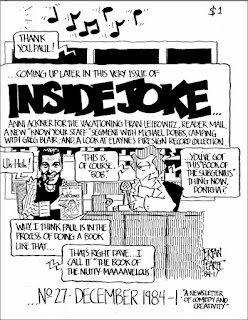
In 1980,  Elayne began publishing a zine called Inside Joke that started out in the obscure area of Uncle Floyd fandom, which gradually evolved into one of "comedy and creativity." 

There were no personal computers in those days, and certainly no desktop publishing software. Publishing like this meant paste-ups -- cutting out typed text, arranging it, and attaching it to other pieces of paper with glue sticks.  Headline fonts meant buying rub-off letters in craft stores , creating the headlines on paper and pasting them on the paper above the text.  Publishing a zine was a labor of love and time, and Elayne did it EVERY SINGLE MONTH for a decade.

By the fall of 1981, Elayne had convinced me that I should write for Inside Joke. I don't recall feeling an urge to write before then, though I'd always had an easy time writing papers for school.  But Elayne convinced me to write book reviews, which then turned into other articles, and presaged the kind of writing I would do years later, when in 1998 I would start doing online movie reviews, and in 2004, I would start that other place.

One day in late May of 1983, Elayne dragged me out of the house because it was time to run off the latest edition of Inside Joke.  I'd had a run of incredibly bad boyfriends and even worse dates, and after the previous night, in which a first date consisted of listening to a guy cry over his ex-wife and talk about his experiences with EST, I'd decided that finding a Special Someone was never going to happen for me. This knowledge had me barely able to get out of bed, but Elayne is the irresistible force that can move the immovable object, and I reluctantly agreed to go.

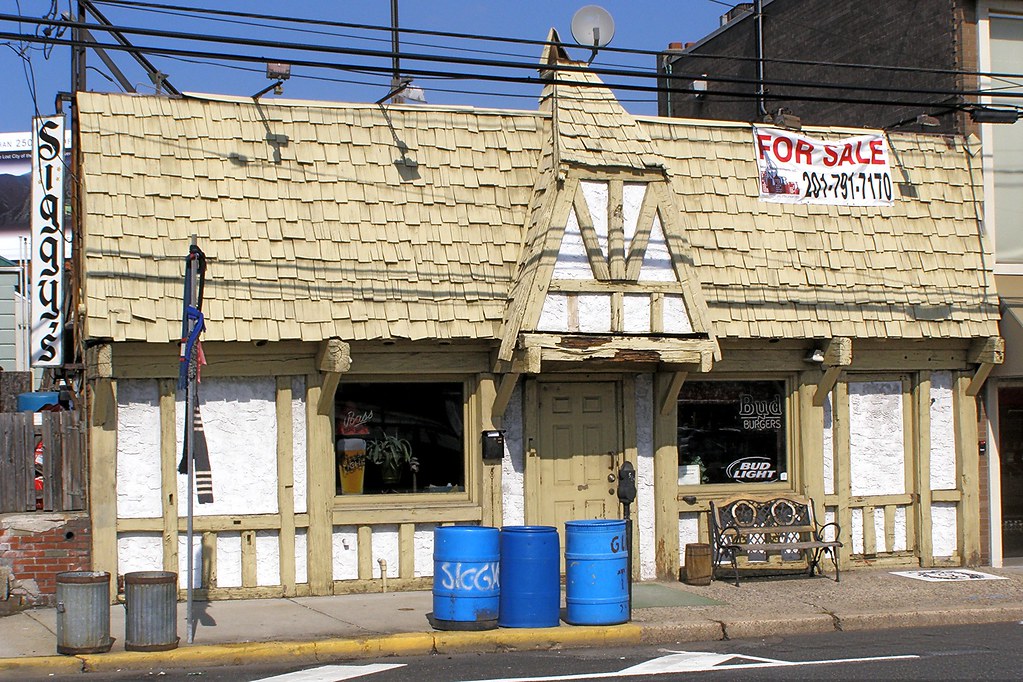
So Elayne, Anni and I sat in Elayne's car across the street from Siggy's Bar in Fort Lee, New Jersey on a Saturday, bitching about men and waiting for some guy named Steve, who worked for a market research firm and had access to high-speed collating copiers, to arrive by bus.  I pointed out a very handsome young guy, sauntering across the street in a yellow striped polo shirt and white cargo pants, a cigarette hanging out of his mouth, and said "See that guy?  That guy thinks he's God's gift to women."

The bar formerly known as Siggy's


And then That Guy got into the car.

That Guy, fall 1983, smoking and looking very much like he did on that day in May.


I will never know if Elayne was doing a shidduch that day.  She doesn't have a photographic memory of that day the way I do.  But I vividly remember rattling off one weirdo pop cultural touchstone after another -- from the ones I mentioned above, to the surreal genius that was Ernie Kovacs, to the 1969 New York Mets season, to the WMCA Good Guys -- the DJs on the AM rock 'n' roll station that in the 1960s was the "cool" one to listen to.  If I'd had better self-esteem, I might have noticed that That Guy's eyes were lighting up with each weirdo pop culture reference we had in common. But I think it was that we both remembered Gary Stevens, the evening WMCA DJ, and his imaginary sidekick The Woolyburger, that sealed the deal.  You see, when I was a kid, we had a poodle that we'd named Woolyburger.  She was the best dog I ever knew.  But Gary Stevens went off the air in 1968 when Woolyburger the poodle was only three, and for the next eleven years, I had to explain to people what her name meant.  This became especially difficult in my early teens, when people tended to think it was about pubic hair.

But That Guy, a.k.a. Steve, a.k.a. Mr. Brilliant, knew who the Woolyburger was.  And the rest is history.

Gary Stevens with the Woolyburger in 1965
 
Elayne and I lost touch again after a while.  I'm not sure why.  I think that when Mr. B. and I got married, and we went from dead-end jobs to careers and we became homeowners, our pop culture weirdo status became less noticeable even to us. Elayne kept moving further out in Brooklyn and Anni moved to Reading, PA, and I suppose it was inevitable.  Elayne followed Inside Joke with Four Alarm Firesignal (a.k.a. Falafal), a  new fanzine devoted to the Firesign Theatre alas now consigned to the dustbin of history.  Later on, we both started blogs, and then there was Facebook, and well, we became friends again, hopefully permanently this time, though we live even more miles apart now. Elayne is one of the few people in the world who even know that Mr. B. ever even existed, never mind having this shared memory and such a huge role in my life. But those days in the 1980s were good times.  They were zany and creative and ironic and fun and Elayne is a true American original.   
 
We may not be able to return, but we can look behind from where we came, and I'm thrilled to let you all know that you can too, because Inside Joke -- all ten glorious years of it -- are now available in PDF format for all time.  IJ is a time capsule, but more than that, it's a reminder of when long-form writing was cool, It wasn't about clicks or monetizing or being followed on Twitter.  It was just a bunch of weirdos screaming into the void, hoping other weirdos would read it and find kindred spirits.
 
See you in the funny papers.
 
http://doctechnical.com/insidejoke/
Inside Joke, December 1984